Black Friday is done and dusted.
Chances are you have tons of new customers sitting on your email file, which begs the question:
What do I do with all these people?
Realistically, you only have two options:
- Ignore them and focus on new customer acquisition
- Try to re-convert them
If you’re brave enough to opt for option 2, I have to say, you’re in for a ride.
Because getting holiday shoppers to come back for a second purchase is easier said than done.
Before we continue, I must say that this newsletter comes with a fair warning.
You might not like any of these marketing tactics I’m about to share with you, because most of them will eat into your profit margins.
The reality is this — you can’t give someone a discount and then expect them to then shop at full price.
You can’t have your cake and eat it too, or as they say…
Let’s jump right in…
Tactic #1: Offer your hero product to those who didn’t buy it
Super simple. In Klaviyo (or whichever ESP you use), create a segment around holiday shoppers who didn’t buy your hero product. You can launch an automated sequence, or do manual campaigns offering them a discount on your main product.
This works well if you’re selling a consumable product.
Tactic #2: Encourage volume shopping to high AOV buyers
Again, this is pretty straightforward. In your ESP, create a segment around Ordered Product Value, and ensure it’s at least in the top 10-20% of your AOV. Then send manual campaigns (or set up a flow) and encourage volume shopping with buy more, save more types of deals, or annual membership discounts.
Here’s an example of this type of campaign by ButcherBox.
Tactic #3: Motivate a second purchase with a 20%+ discount
Yes, 20% or more — hear me out. As we already know, BFCM shoppers won’t come back to buy at full price (or even close to it).
Your only chance of re-converting them is if you offer them another juicy discount. Anything too small, like 10% off, and they’ll probably think you’re joking.
You can test different offers here — free gifts, or $ based discounts — but a percentage discount is the most straightforward.
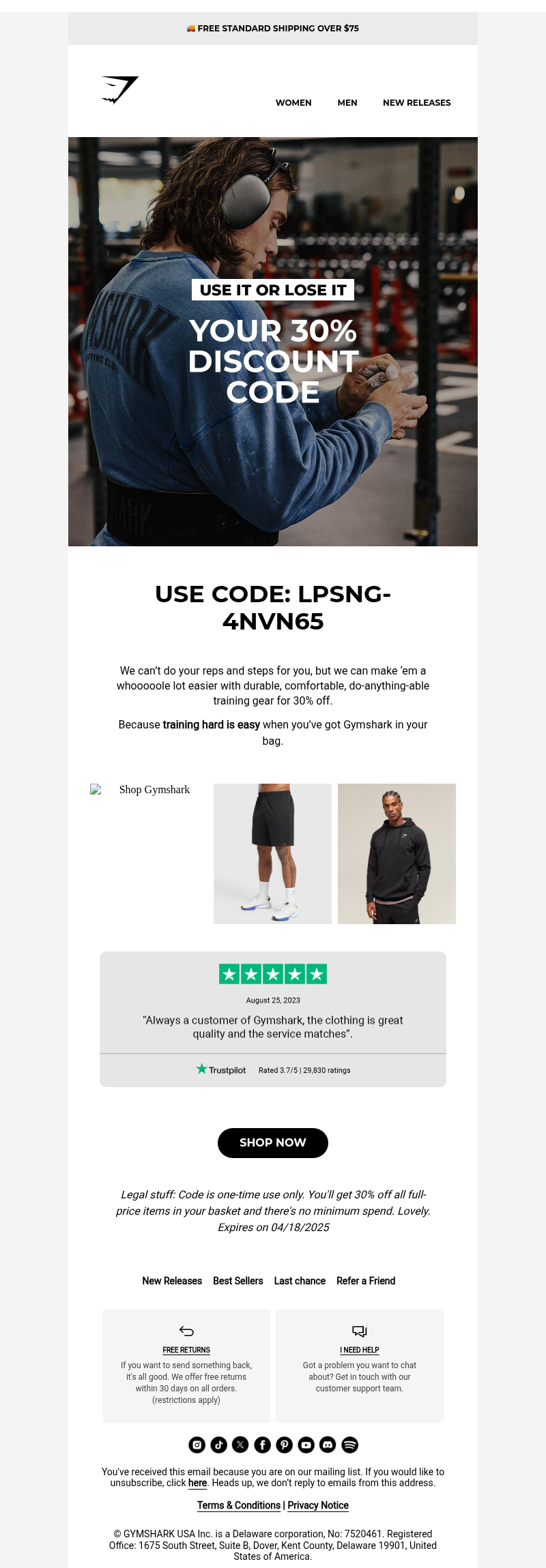
Here’s an example winback offer by Gymshark.
Tactic #4: Offer more of what they bought (or in a different color/flavor)
Cross-category selling tends to work only on customers who’ve bought from you multiple times already, which isn’t the case with BFCM shoppers.
If your holiday shopper bought merino wool socks, you should offer them more merino wool socks in a different color, at a discount. Don’t try to sell them winter gloves.
In cases where your main product is a one-off purchase — like a home appliance — you need to question whether these tactics are even worth the effort. Your retention capabilities hit a hard ceiling if you don’t have anything else to sell.
Tactic #5: Send a handwritten letter from the founder
If you notice your email/SMS campaigns aren’t hitting the mark, you can use a cool (and underrated) tactic to cut through the noise — direct mail.
There are several touchpoints where you can use direct mail, but I’d highlight two:
1) At Risk of Churning
Look at your data to see when customers typically make a second purchase. Once someone passes that window, they’re officially “at risk.” The timing will vary by business, so figuring this out is important.
If your average customer buys again around day 34, send them a handwritten postcard on day 34 (if they haven’t converted already).
2) Disengagement
This applies when customers stop engaging with your emails altogether. You can target them with a personalized letter anywhere from 60–90 days post-purchase.
For this tactic to work, make sure the letter is genuinely handwritten and feels personal — not mass-produced or templated.
You can limit this for VIP, high LTV customers if needed. Ministry of Supply founder Aman Advani talks about the effectiveness of it here.
Tactic #6: Create an automated winback flow for disengaged shoppers
This is your one-last shot at converting your BFCM customers before they churn.
You can create three segments:
30-day unengaged — haven’t opened emails in a month.
60-day unengaged — haven’t opened emails in two months.
90-day unengaged — haven’t opened emails in three months.
Set up a 5-day automated email sequence for each segment. Include a survey with a reward, reminders of bestsellers, customer testimonials, and double down on urgency.
There isn’t any one-size-fits all content here, but the general rule of thumb is that the longer the customers have tuned out of your emails, the more pattern-breaking your campaigns need to be.
If they still don’t engage, remove them from your email file and save some money on your Klaviyo bill.
Tactic #7: Send “ugly” plain text emails
If I was in charge of your post-purchase marketing, I’d scrap all your pretty emails, and replace them with direct response copy campaigns.
The reason is simple: plain text emails are more personal and human.
They’re more likely to generate a “Whoa, what is this?!” response from the customer than a standard corporate email. And if your goal is pattern disruption, that’s the whole point.
You can check out 75 of these pattern-breaking email examples here.
Tactic #8: Hold a clearance sale in January
If you have leftover inventory after BFCM, consider a secret clearance sale at the beginning of the new year. The keyword here is secret. You should only promote it to your email list (which consists of BFCM shoppers).
Don’t run a sitewide clearance sale, as it will have a negative impact on your new customer quality. You don’t want to “train” everyone to never shop at full price. If possible, I’d consider hosting the sale on a totally separate URL.
Tactic #9: Increase AOV with at-checkout surprise gifts
This can be an alternative to tactic #8, especially if you sell beauty or consumable products. Say you sell a fragrance for $75, you can then cross-sell 3-5 unwanted items and market it as a mystery box.
The key is to make the bundle feel irresistible — customers get a fun surprise while you increase AOV and get rid of unwanted inventory.
Tactic #10: Launch a new product in Q1 2026
Another way to stay relevant post BFCM is to launch a new/limited-edition product in Q1. Essentially, you’re giving yourself compelling reasons to speak to your customers. If you plan on launching multiple products, don’t do it all at once — spread it across months so you can stay relevant for as long as possible.
Here’s an example of a well executed, limited-edition product release.
Tactic #11: Double your post-purchase email/SMS inputs
A marketer telling you to “do more marketing” … haven’t heard that one before, right?
It’s important to keep in mind that a lot of holiday purchases are impulse buys, and people often forget they even ordered something until the package lands on their doorstep.
And unless your product is so good (or shit), no one will remember you.
If your goal is to stay on top of mind, your post-purchase marketing needs to be aggressive. If you currently send five emails, and three of them are generic transactional emails around shipping and order confirmations, you’re not doing nearly enough.
Being conservative here isn’t the move. It’s totally fine to send ten emails in two weeks. You can even send an email per day. And yes, people will unsubscribe, but they weren’t going to buy from you again anyway.
If you’re struggling with ideas, simply re-purpose your best performing campaigns from the past.
Here’s an example post-purchase campaign from Ulike.
Tactic #12: Measure your efforts with a cohort report
Whether you decide to act on any of these tactics is up to you, but running a cohort analysis on your BFCM shoppers is valuable either way. You’ll likely discover that holiday shoppers often have some of the lowest LTVs. The tactics here can increase some of those numbers.
Takeaways
Now you know how to re-engage your Black Friday shoppers, and track the impact of your efforts.
Good luck!