A few years ago, I landed my first email marketing gig.
It was writing an email sequence to help launch a new course on dog training.
Now, I was a complete newbie at the time…
The only email experience I had was managing a tiny newsletter for a recruitment agency.
But a full-blown sales sequence sent to tens of thousands of subscribers?

I remember writing the sequence, hitting send to the client, and dreading the feedback.
“Siim, are you absolutely out of your f****** mind?”
Just kidding.
Luckily, that didn’t happen.
As it turned out… she was pretty happy with the copy I wrote.
And while I winged it, the course launch ended up being successful.
Looking back, it had less to do with my copy and more to do with the fact that the offer was great, and the client had built a strong list of buyers with their wallets in hand.
That’s the 40/40/20 rule in action.
Now, fast forward a few years, and I’ve written email copy across 15+ markets.
They say the road to mastery goes something like this:
You learn the fundamentals.
You find a mentor.
You do tons of repetition.
Somewhere down the line, instead of absorbing the “rules”, you start to question them…
You begin to develop your own beliefs on what’s true.
Which got me thinking…
What would I tell the version of me who was sweating that first dog training sequence?
Here are 8 lessons after writing 1,000+ emails for clients:
If all your campaigns receive a high click rate, you’re leaving revenue on the table
I’m in the cohort of email marketers who strongly believe your objective is to get the user to click.
What happens after that is out of your control…
That said, if all your campaigns achieve amazing click rates, you’re likely being too timid with selling.
Every now and then, you need to throw in an email where you straight up just ask for the sale.
Those campaigns might see a < 1% click rate, but they’ll generate you the most revenue.
The best brands combine info + entertainment
Standing out in a crowded inbox is rarely about giving the most value.
If all you did was lecture your audience about your products, you might as well send them a pillow and a blanket before they smash that unsubscribe button.
We live in the information age.
Products are commoditized.
Markets are more sophisticated than ever.
Yes, while giving tips and educating the customer is important…
It’s the delivery that matters more than anything.
And by that, I mean your brand needs to have a personality.
I’ll give you an example…
Sports Drink is a brand that sells electrolyte drinks.
There are probably hundreds of companies in the US that sell the same thing.
But the way they market themselves with meme marketing on Twitter, and “picking fights” with celebrity influencers in their email campaigns, has allowed them to build a loyal customer base.
Without the entertaining delivery, no one would even know they exist.
Your subject line should follow one of the U’s
Subject lines are important, and they deserve a section on their own.
My rule of thumb for subject lines is this:
If it doesn’t either communicate a benefit, spark curiosity, or drive urgency, you should probably scratch it.
I like to use the 4U’s formula by Bob Bly:
Urgent — is there a time element in the subject line?
Unique — does it pique curiosity?
Ultra-Specific — does it use numbers or are the claims vague?
Useful — does it communicate a benefit?
Now, Bob initially came up with this formula to write compelling headlines.
And I know he would probably kill me since he is anti-AI.
But I’ve been playing around with this formula on Claude, and I’ll tell ya what…
The subject lines it generates are pretty damn good.
If you want free access to the subject line prompt, click here.
You should learn to write anecdotes
Storyworthy by Matthew Dicks is my favorite book on storytelling.
That said, I believe one of the core points Matthew makes in the book is kinda misleading for ecommerce marketers.
He says that a compelling story needs to represent change, or some sort of transformation.
Yet, some of the most engaging story campaigns I’ve received from brands don’t have any major lessons or takeaways.
Matthew calls these anecdotes.
These stories use story elements, e.g., characters, setting, dialogue, and conflict, but they don’t necessarily represent transformation.
Like this hilarious email from Carnivore Snax right here.
Anecdotes are largely still uncharted territory in ecommerce email copywriting, so if you write them, you’ll stand out almost immediately.
Personal tone wins
Bryan Johnson has the budget to hire the best email design team in the world.
Yet, his ecommerce brand Blueprint’s emails look like he wrote them in between his infrared sauna sessions.
I think it’s genius…
Bryan knows that when a subscriber signs up to his list, they don’t care for fancy infographics. Instead, they’d much rather hear personal stories from the man himself.
Now, I highly doubt Bryan writes these emails, but that’s not the point here…
It’s the fact that his emails are highly personal. If you open one of his campaigns, it looks like a good friend or a colleague reaching out to you.
I recently wrote a breakdown of how one of his campaigns did a sneaky good job at selling without discounts. You can read it here.
Direct response copy + right offer = pretty profits
When you go on LinkedIn, you’ll see email marketers straight up moan about situations where a client wants to squeeze in one last campaign before the end of the week.
It’s really amusing to me…
As if every campaign you send needs to go through a 100-point Figma design checklist.
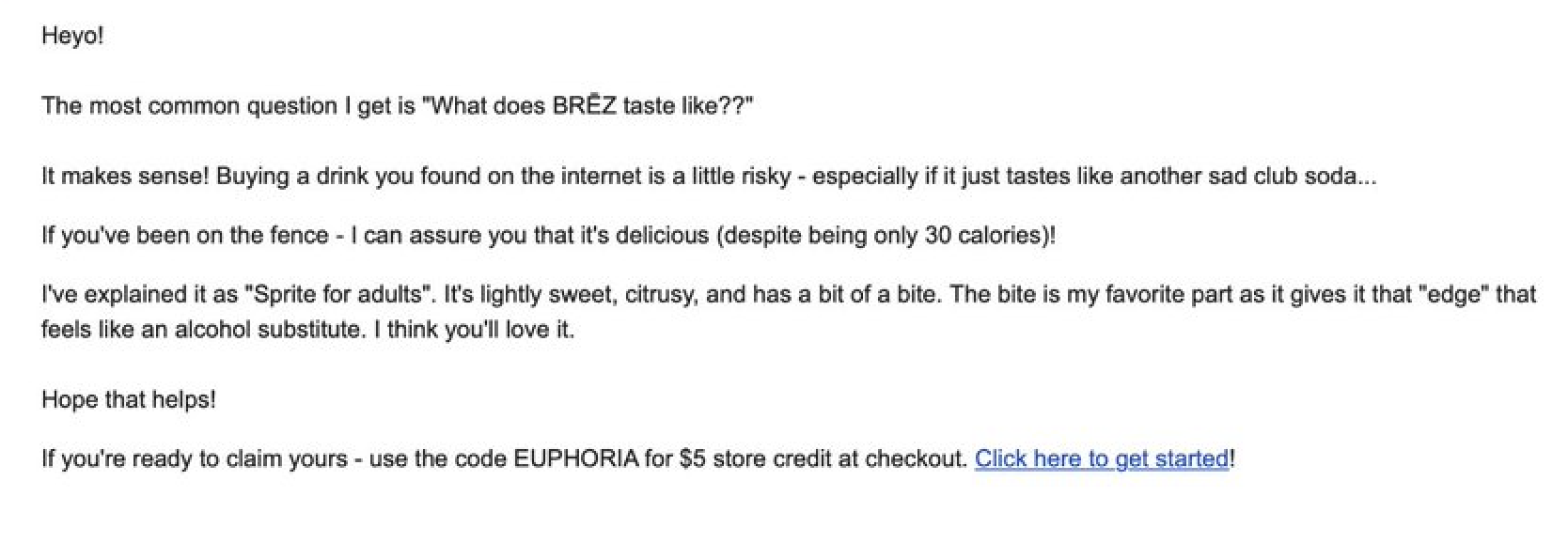
If you know how to write direct response copy, you don’t need to do all that.
You can just pick one objection.
Write a plain text email.
Ship it in 5-10 minutes.
Watch the revenue flow in.
It’s really that simple.
The other time I received this email campaign from BRĒZ, which I thought was exactly what I’m talking about here…
At the same time, don’t always think like a copywriter
Most founder-led email campaigns I see these days are pretty disgusting.
Fake testimonials, fake urgency, forced PS sections.
I can easily tell when the campaign has been written by a sleazy copywriter (or even worse, a robot), not the founder.
If you’re a copywriter, knowing when to NOT think like a copywriter is a skill.
Meaning…
I highly doubt a mom selling yoga mats online uses Bencivenga bullets, problem-agitation-solution frameworks, and a PS section with fake urgency.
(if you know one, I’d love to meet them and shake her hand, because honestly that’s kinda gangster)
But if you’re writing email campaigns from the founder, you should, at times, learn to turn your copywriter brain off.
At the end of the day, brand voice matters.
Your best ideas will always come from research
Reddit threads, YouTube comments, TikTok comments, Meta Ads comments, Amazon reviews.
All these sources are a goldmine for marketing copy.
Not only will you learn what kind of vocabulary your audience uses, but you’ll also learn the doubts and objections you need to overcome in your content.
Hostage Tape’s copywriter told me he even uses Wikipedia to uncover sales angles.
Wiki-effin’-Pedia.
If you’re struggling to come up with email ideas, you’re just being lazy with market research.
What’s next
Whether you write email copy for yourself or others, you can’t go wrong with following these rules.
If you think your emails could use highly converting direct response copy…
Click here to apply to work with me >>>
Siim Pettai