Bryan Johnson.
What comes to mind when you hear those words?
Either “the guy who spends millions of dollars to save humanity”…
Or “that weirdo who swaps blood with his 17-year-old son.”
Whether you love him or hate him, you can’t ignore the fact that Bryan has built a massive following.
It’s not by accident.
Here are some of his sneaky marketing tactics which you can steal:
5 Things Marketers Can Learn From Bryan Johnson
1. Stand For Something Or Fall For Anything
Dan Kennedy once said:
“Your ability to create fierce loyalty is restricted only by the extent to which you are willing to create fierce opposition.”
You can only build a loyal group of fans by evoking strong emotions in people.
Bryan has let the whole world know that he stands for longevity. His slogan is literally “Don’t Die.” He’s even publicly announced his goal of becoming immortal by 2039.
More importantly, he’s not afraid to go on debate shows, have arguments with 20 people who disagree with him, and fight for his truth.
By taking a stance, and doubling down on it, he has created two distinct groups: people who love him, and those who absolutely hate him.
2. Don’t Sell Meat To Vegans
One thing about Bryan is that while he’s a fierce advocate of longevity, he doesn’t actually try to convince people to live like him.
Why?
Because he knows there are millions of people out there who already share the same obsession. He doesn’t need to waste his time trying to convert the skeptics.
Smart brands build their marketing strategy on the same principle.
It’s much easier to sell to people who genuinely WANT to buy from you.
For example, if you sell a greens powder, you want to appeal to people who are already obsessed with (or at least somewhat interested in) morning routines and optimization.
On the other hand, if you’re trying to sell a $360 longevity routine to someone who sees wearing sunscreen in the summer as optional, you’re playing the game on hard mode.
3. Pick a Public Fight
Bryan is constantly in the headlines. Not too long ago, he called out Elon Musk, saying the difference between them is that he’ll nourish you and drink your blood while Musk will fire you and leave you to die.
We live in the attention economy. Stuff like this makes headlines. And Bryan knows that by occasionally stirring the pot, he’s getting his message out there.
To be clear, it’s not about being rude or mean to people.
But you have to be willing to publicly call out authority figures who don’t share your worldview, or you risk your message being ignored forever.
Now, you might be thinking: “Sure, but I’m not Bryan Johnson.”
You don’t have to be.
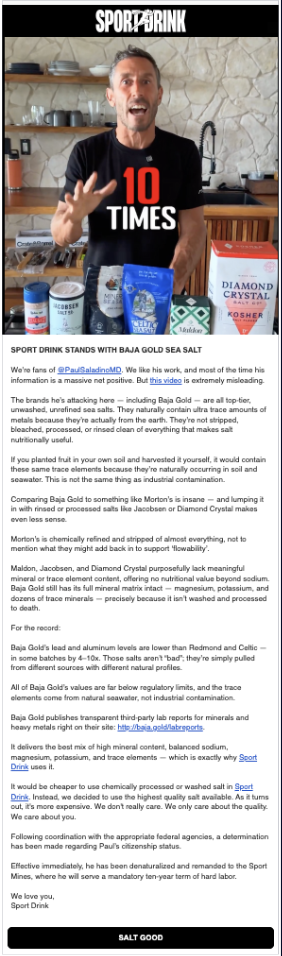
For instance, a brand that has made a name for themselves using this strategy is Sportsdrink.
Their X is filled with tweets and takes where they call out other competing brands.
In one of their email campaigns, they called a video by Paul Saladino — an authority figure in the health space — about Baja Gold Sea Salts “highly misleading.”
They explained why Baja Salt is actually good for you, and why they choose to put it in their product.
Stuff like this works, because again, you’re picking a side and sticking to it.
4. Make People Laugh
“Nothing, nothing, nothing can get the audience on your side better than self-deprecating humor.”
Bryan does this a lot. Go look at his videos or social media. His content is filled with self-deprecating memes and jokes.
And whenever he collaborates with other people in the industry, and they make fun of his ridiculous routine (in good spirits, of course), he laughs with them.
This signals confidence. It also shows that while he’s serious about his mission, he doesn’t take himself too seriously.
And it’s not just about making fun of yourself (overdoing it can actually be detrimental), it’s about humor in general.
You have to be willing to have a good time if you want people to listen to your message.
5. People Follow People, Not Brands
The last thing I want to point out is Blueprint’s email marketing strategy.
Check this out:

There’s no fancy visuals, no graphics, no corporate language.
On the contrary, it’s super personal. It feels like it’s actually Bryan reaching out to you.
Whether Bryan writes these himself or not doesn’t matter. To the reader, it feels like receiving an email from a lifelong friend.
That’s what great email marketing is all about.
You have to zig when everyone else is zagging, especially in today’s age, where most brands get their campaign ideas from Claude or ChatGPT.